Risk Management Guide for Traders
There are many important things to manage, but nothing is as important as Risk.
I’m a former Prop Trader and I’ve been trading Crypto for 8 Years.
First I want to say thank you for taking time out of your day to click on this article and give it a read. Your time and attention are very valuable resources, so I am grateful for you to give some of it to me.
In exchange, I will give you everything I know about Risk Management.
I have done my best to simplify everything in here for you.
✍️ Let’s get started ↓
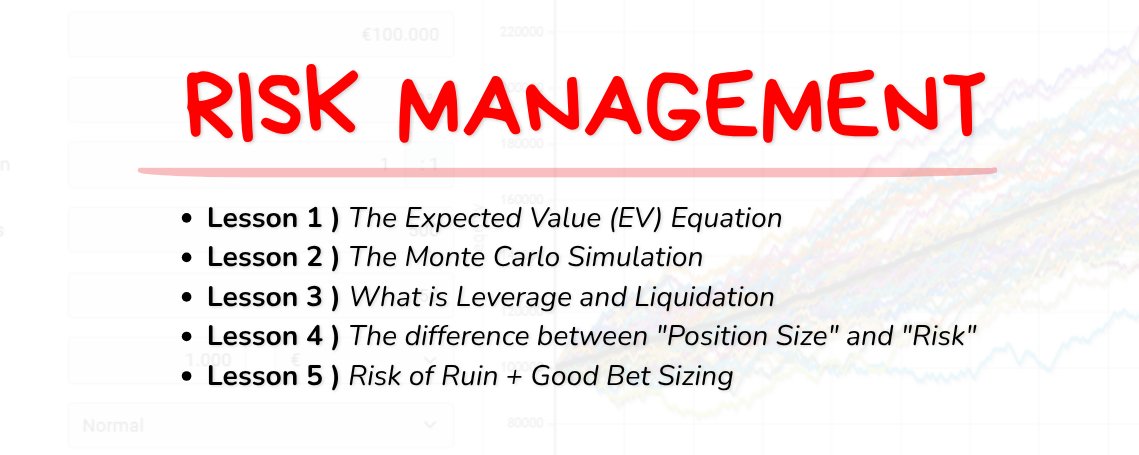
Overview
- Lesson 1 ) The Expected Value (EV) Equation
- Lesson 2 ) The Monte Carlo Simulation
- Lesson 3 ) What is Leverage and Liquidation
- Lesson 4 ) The difference between “Position Size” and “Risk”
- Lesson 5 ) Risk of Ruin + Good Bet Sizing
Lesson 1: The Expected Value (EV) Equation
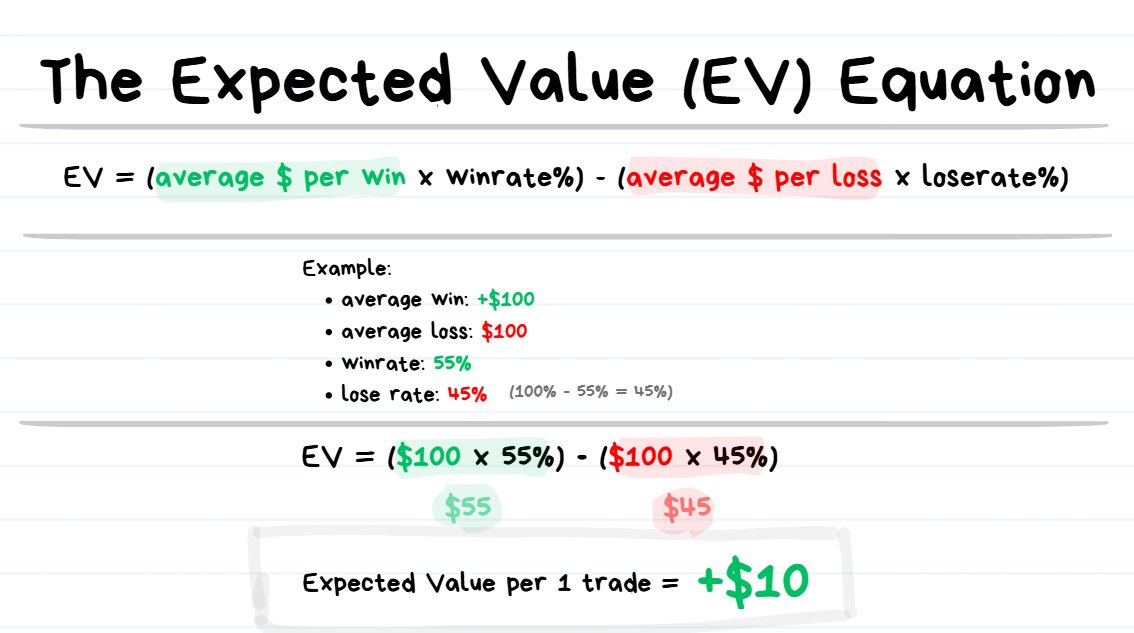
EV= (Average Win x Win%) − (Average Loss x Loss%)
❗️TIP: Expected Value = the average outcome you can expect if you repeated the same decision over and over.
Every single Trader NEEDS to know what Expected Value is and how to calculate it.
🤔Why is EV so important?
- The Expected Value of a Trade allows us to estimate what our expected profit will be over the next N number of trades.
In the image example I shared above, if you have an expected value of +$10 per trade, then if you take 1000 of this exact same trade then your average “expected profit” should be roughly $10 x 1000 = $10,000.
- If you have a POSITIVE EXPECTED VALUE (+EV) , your trades will win money over time.
- If you have a NEGATIVE EXPECTED VALUE (-EV), your trades will lose money over time.
In the section below I will talk about the Monte Carlo Simulation which helps visualize this. ↓
Lesson 2: The Monte Carlo Simulation
In this Lesson I’m going to cover a few things:
- The Monte Carlo Simulation
- Variance
- The Law of Large Numbers
- How these 3 things above related to Trading
This might look scary because of numbers, fancy names and graphs, but I promise it’s fairly simple to understand.
I believe having a basic understanding of these 3 topics will make everything to do with Risk Management easier to digest.
First let’s quickly cover the Monte Carlo Simulation ↓
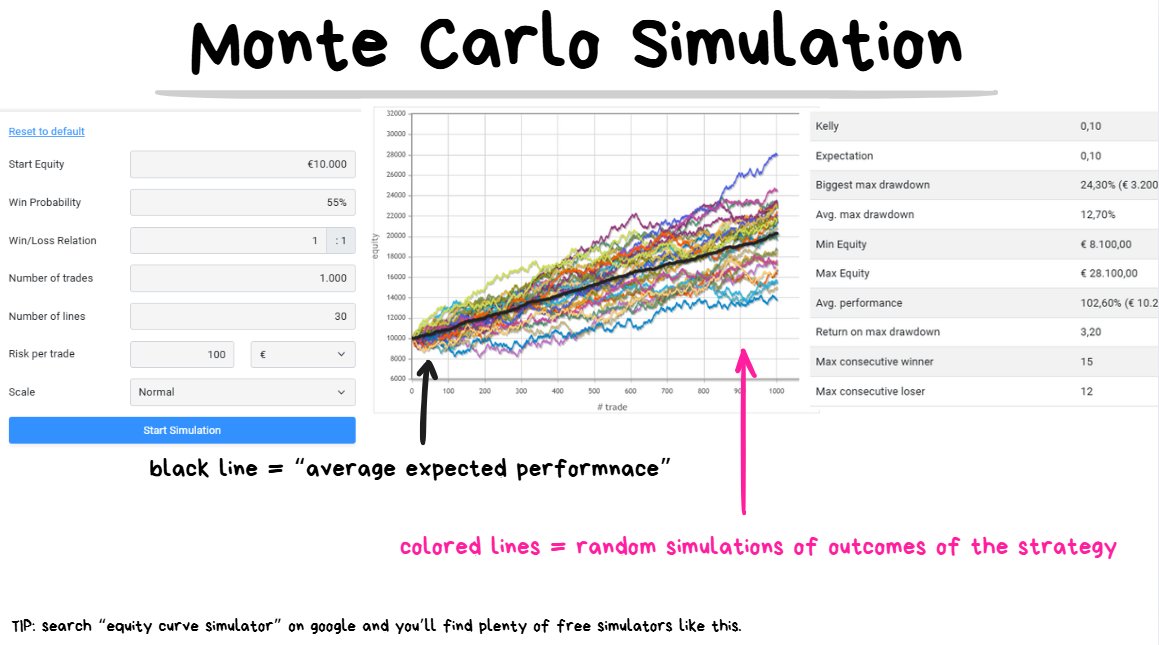
30 simulations of how performance can look like with a 55% winrate, 1R strategy over the next 1000 trades. This is a profitable (+EV) strategy.
❗️TIP: Monte Carlo simulation = running lots of random “what if” scenarios to see all the possible outcomes after taking N number of trades.
A Monte Carlo Simulation can help us manage expectations and also give us a rough idea for how profitable our strategy is.
We input our starting balance, winrate %, average win/loss ratio and the # of trades, and the simulation will spit out random combinations for how our performance can look like.
The thick black line visualizes the “average expected outcome”.
So if our EV per trade is +$10 and we take 100 trades, our total profit will be “roughly” +$1000~ . If we take 1000 trades with the same strategy then our total profit will be “roughly” +$10,000.
Notice the emphasis on the word “roughly”. This is because it cannot be guaranteed and there can be a bit of variance.
Secondly, let’s quickly talk about Variance ↓
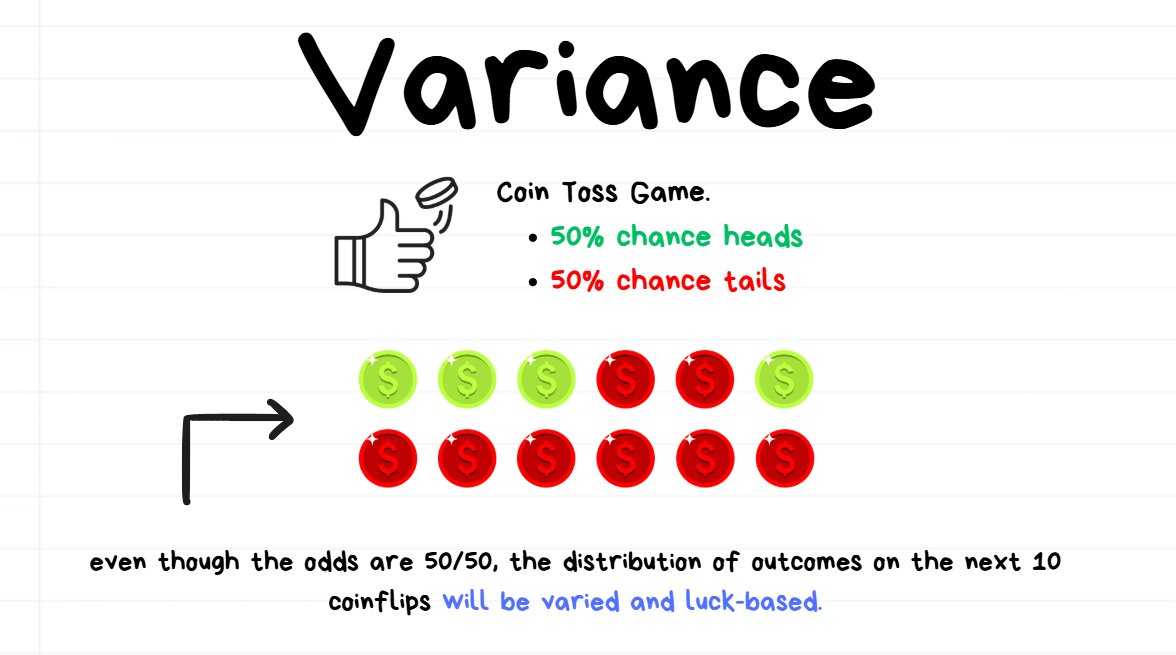
“Randomness” plays a role in our trading performance, whether we like it or not.
🧠Here is a Coin Flip analogy
- Imagine you are playing a Coin Toss game with a 50% chance of getting either heads or tails.
- If you flip the coin 10 times, it is possible to get heads 8 times and tails 2 times. Despite the chance of landing on heads is 50%, it landed on heads 80% of the time.
- This DOES NOT mean that the coin is rigged and has a 80% chance of landing on heads.
- It just simply means that the coin has not been flipped enough times for the probabilities to properly play out.
- The difference between “actual outcome” (80%) and “probability” (50%) is the variance (80% - 50% = 30%)
- If you were to flip the coin 10,000 times, you might get 5050 heads and 4950 tails. Even though the the raw difference is +50 more heads than expected, in percentage terms there is only 0.5% (50 ÷ 10000) of variance.
Thirdly, let’s quickly discuss The Law of Large Numbers ↓
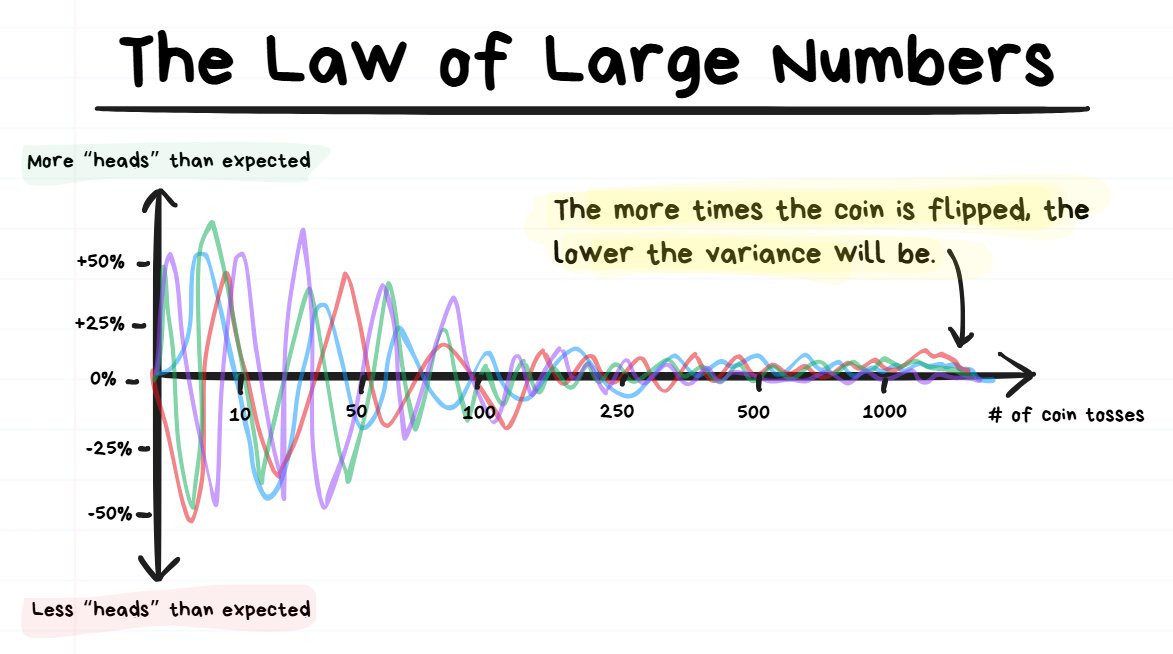
The more times that a coin is tossed, the closer the Variance gets to 0.
❗️TIP: The “Law of large numbers” means the more times you repeat something random, the closer your results get to the true average.
If you play the coin toss game only 10 times, there is going to be a lot of variance in the % of times that the coin landed on heads.
If you play the coin toss game 10,000+ times, there is going to be very little variance in the % of times that the coin landed on heads.
Basically the more you times an event happens, the closer the outcomes will start to move towards the “real probability”.
How does a Monte Carlo Simulation, Variance and Law of Large numbers all relate to Trading?
The Monte Carlo Simulation allows us to manage our expectations (baed on the variance) over how our next N number of trades are going to play out. The more trades taken, the less variance we can expect.
- How much expected profit should we see after N trades?
- How many consecutive wins we can expect to see?
- How many consecutive losses can we expect to see?
- How much of our account is it “normal” to lose with this kind of winrate and risk/reward ratio after N trades?
It’s also a “slap-in-the-face” reality check about certain truths:
- Even highly profitable strategies can go through extended periods of drawdown. (Drawdown = how much % have you lost in the account)
- Even high win-rate strategies can go on large consecutive lose streaks.
- Even terrible, low win-rate strategies can go on large consecutive win streaks.
- The outcome of the next trade we take DOES NOT MATTER. What matters is the outcome of the next 100+ trades we take.
The Main Takeaway
→ Sometimes you’ll make a good trade and lose.
→ Sometimes you’ll make a bad trade and win.
It’s going to happen because of variance/luck.
Judging whether or not you made the good trade based on 1 outcome is not the way to go.
Two Extreme Examples ↓:
- You take a trade based on a pattern which has a 90% success rate with a Risk/Reward ratio of 1: If you take the trade and it loses, it was still the right call. This is because if you were take the same trade 1000+ times and let the law of large numbers play out, you would be printing money. ✅
- Playing at a Slot Machine in a Casino: If you win once, that doesn’t make it a smart bet. You just got lucky due to variance. If you keep betting 1000+ times and let the law of large numbers play out, then you would get wiped out for all of your funds. ❌
The point: Don’t judge your trade quality based on whether the next trade is a win/loss. Instead judge them by their expectancy. You will need to be patient and sit through some variance before the profits start rolling in.
Lesson 3: What Is Leverage and Liquidation?
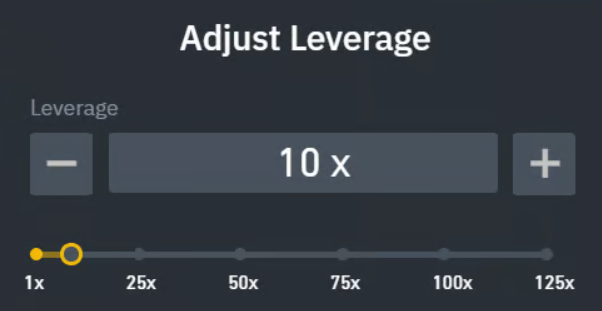
Leverage is probably one of the most misunderstood concepts for Traders.
🤓QUICK NOTE TO READER: Before reading everything below I want to make it clear that you DO NOT have to remember every single thing below, so don’t stress.
As long as you get a “basic understanding” of what leverage is, you’ll be fine.
👨🎓 Mini Test: Do You Understand Leverage?
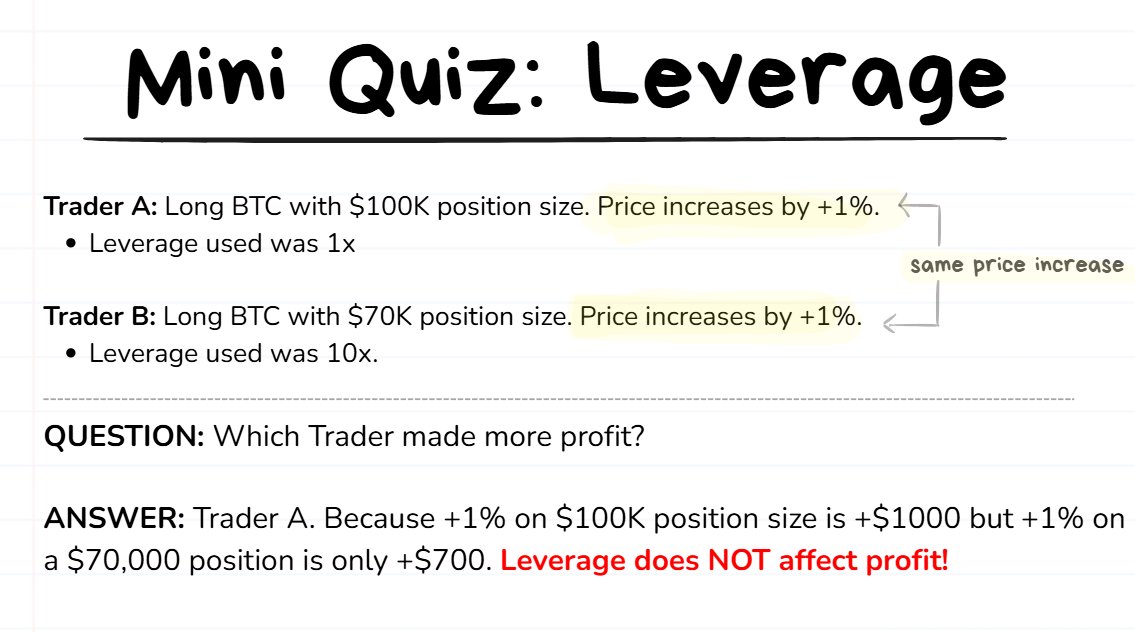
(assume the entry price of both traders is the same)
What most people think Leverage is (but it is DEFINITELY NOT this ❌):
- A turbo profit multiplier, such when you slide it up it magically increases how much money you’re going to make on the trade.
- I promise you, leverage is NOT this.
What Leverage ACTUALLY is ✅****:
- A tool to reduce counterparty risk and also improve capital efficiency.
- Counterparty Risk = the funds that you risk by holding on an exchange. It is at risk because there is non-zero chance of the exchange rugging/scamming (e.g. FTX).
- Capital Efficiency = how efficiently you can use your money to generate more money. For Example: Needing $1000 of capital to make $1000/month is 100x more efficient than needing $100,000 of capital to make $1000/month.
🤓Before going further, let’s first get some clear definitions on some terms. Then we can return to learning more about Leverage. ↓
- Trading Account Balance: the total capital you are willing to use to execute trades.
- Exchange Account Balance: the amount of money you have deposited onto the exchange. This is naturally going to be a small % of what your entire trading account is. It is not recommended to have your all 100% of your entire trading account deposited onto an exchange.
- Margin: The required money that you need to put up in order to open a trade.
- Leverage: The multiplier of the money that you are borrowing from the exchange.
- Position Size: The total amount of whatever coin that you opened a trade in.
🤓NOTE TO READER: below is a post which shows a flow chart for how I manage deposits/withdrawals from exchanges. The point is to never be “over-exposed” on 1 exchange.
Aug 31, 2025
Serious Traders don’t keep 100% of their funds on an exchange. Leverage is a gift which allows using trading capital without needing to deposit it. Below is the system I use for topping up and withdrawing profits from CEX exchanges as an Altcoin Perp scalper ↓
Example: Leverage in Practice
Pretend you have $10,000 that you are willing to trade with. This is your Trading Account Balance.
You don’t want to deposit all $10,000 onto an exchange because what if the exchange decides to hold our funds, scam/rug or it gets hacked. So instead you deposit 10% of these funds onto the exchange. So $1000 gets deposited onto the exchange. Your Exchange Account Balance is now $1000.
You see a good trade opportunity in BTC and you want to long $10,000 worth of it. If you try to click “Buy”, it will say insufficient funds. Since you only have $1000 in your Exchange Account Balance, you will need to use Leverage to get the required funds to open the position.
- So you put the Leverage to 10x and then you try again and it works.
- Your Position Size (how much of the coin did you actually buy) on the Trade is $10,000.
- Your Margin (how much money did you need to put up “as collateral”) is $1000.
- Your Leverage is 10x.
❗️TIP: The profit on a $10,000 position with 1x leverage or 100x leverage is going to be exactly the same. A $10,000 position will always just be a $10,000 position. You can change the leverage of a trade literally while in the trade, and it won’t do anything to the profit.
The Purpose of Liquidation
When you are getting leverage on a position, you are basically “borrowing” from the exchange. The money isn’t magically coming out of thin air 😂.
If you open a $10,000 position using 10x leverage with only $1000 deposited on your trading account, that $9000 is lent to you by the exchange. Those “borrowed funds” can only be used for opening positions.
In order to ensure the exchange gets their lent money back, they have the Liquidation Function.
⚠️Liquidation: If price hits a certain point (the liquidation price), the exchange will forcefully close you out of your position and collect your margin (the collateral you put up). Then the exchange will be taking over your position instead and the trade will be their problem now.
I want to use an Analogy to make this easier to understand ↓
Let’s pretend that I am bullish on a new iPhone.
The price of this iPhone is $1000. I have a feeling that it’s going to go to $1100 (+10% increase in price).
My idea is I want to try to buy the iPhone for $1000 and then re-sell it for $1100, making a +$100 profit on my trade.
The only problem is that I’ve only got $100 in my bank account.
So I go to Timmy, who is a wealthy individual, and explain to him that I really want to borrow $900 so I can take this bet on the iPhone.
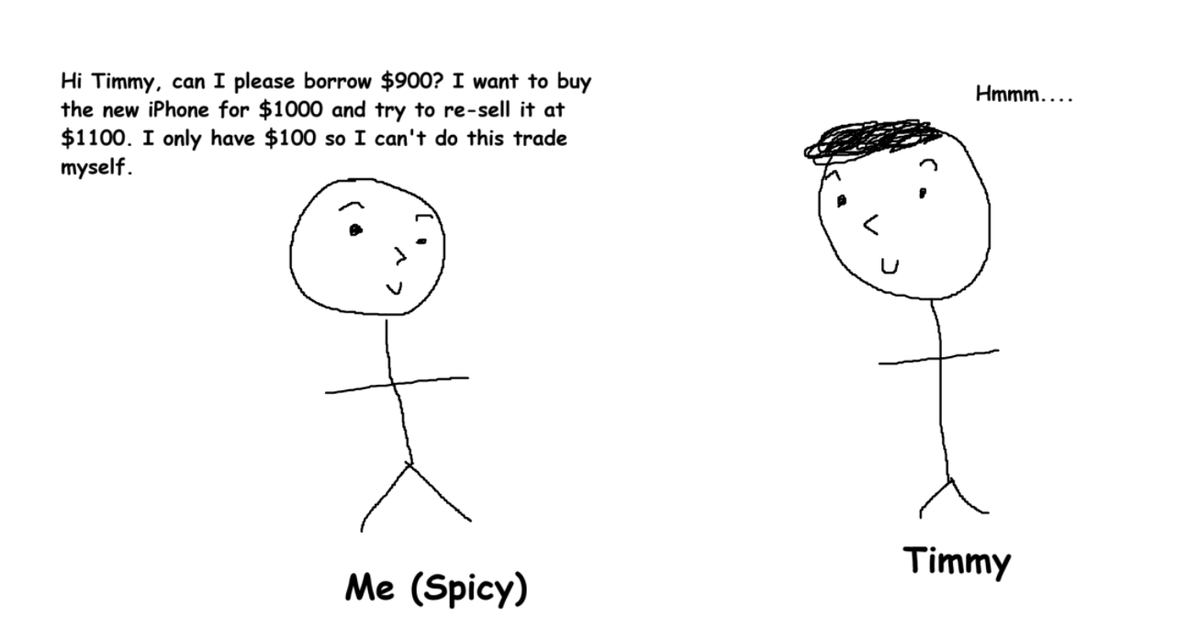
My beautiful MS Paint Artwork: Me asking for a $900 loan from Timmy.
Here is the issue:
- If Timmy lends me the $900 and then the iPhone drops below $900 in value, even if I re-sell it I won’t be able to pay Timmy back in full.
- Timmy will lose money for no reason. Timmy doesn’t like losing money for no reason.
Here’s the solution:
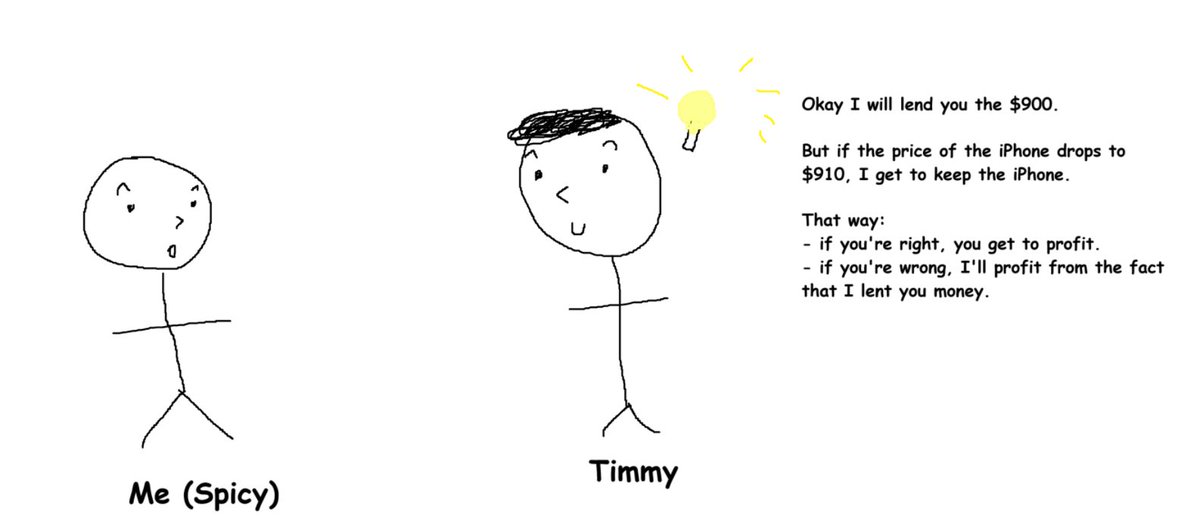
An agreement which benefits both parties is created. (Perpetual Futures Contracts are “Contracts” that are made between the Trader and the Exchange)
- Me and Timmy get a contract made together.
- If the price of the iPhone DROPS BELOW $910, I will have to give Timmy the iPhone that I bought. This is my “position being liquidated”.
- So I will lose the initial $100 that I had (the margin)
- And Timmy will try to sell the iPhone himself. If the price of the iPhone doesn’t move that much and he manages to successfully sell it above $900 , then Timmy will make a profit.
- The reason why Timmy gets to keep the iPhone if it drops below $910, rather than $900, is because Timmy deserves to get some profits for the fact that he lent me some money in the first place.
In Summary
- Traders use leverage to open positions that they want to speculate on.
- The exchange temporarily lends them the “leftover funds” that they need to open the large position.
- If the Value of the position drops below a certain price, the trader gets fully closed out and the position gets transferred over to the exchange.
- The exchange now has to try to get rid of the position.
- The exchange has a very high likelihood from profiting off a liquidation, since the “liquidation price” is always going to be favored for the exchange to give them plenty of breathing room to get rid of the position for a profit.
The Main Takeaway
You don’t have to remember what all of the terms mean.
The most important thing that you need to understand is that leverage is just a tool to help you get the position size that you need.
Also, never ever ever risk getting liquidated. The costs/fees with getting liquidated are absolutely enormous.
❗️****TIP: Always use a stoploss for every trade. It’s incredibly dangerous to trade without one.
Lesson 4: Position Size vs. Risk
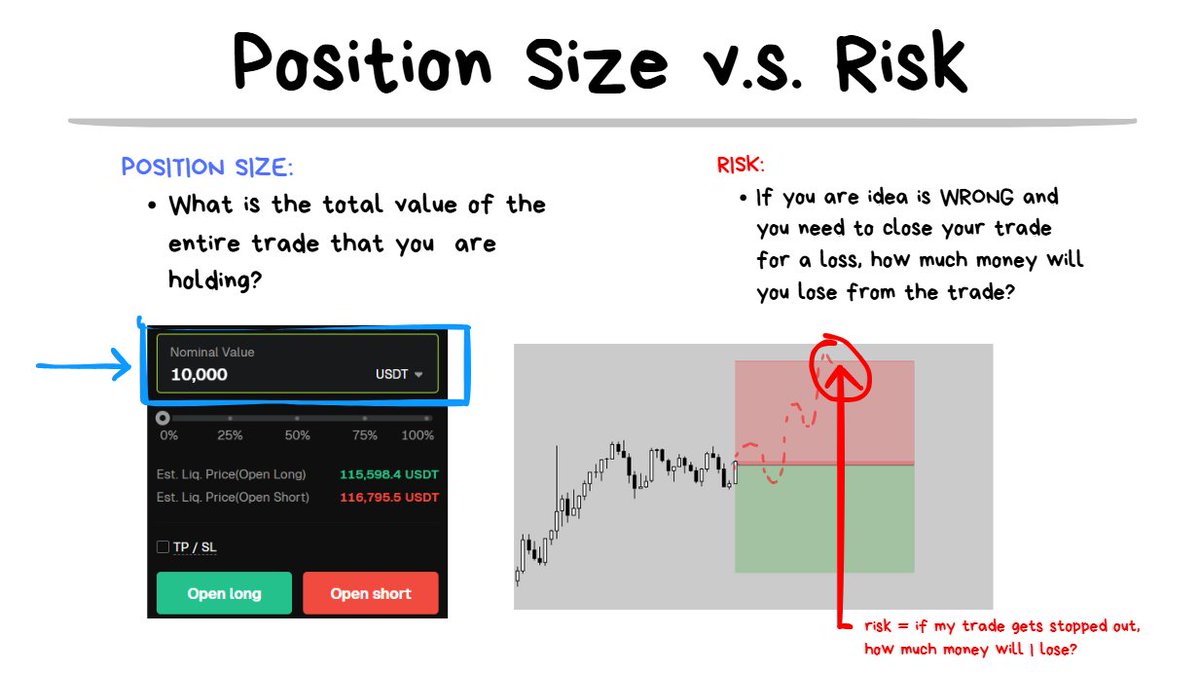
Another topic that is often misunderstood by traders is the difference between Position Size and Risk.
❗️TIP: Position Size = the total number of coins (or the USD value of the coins) that the trade is worth. (e.g. “I bought $10,000 worth of BTC. So position size is $10,000”)
❗️TIP: Risk = the amount of money you will lose if your trade idea is wrong and you need to cut it for a loss. (e.g. “If price hits my stoploss I will lose $100. So my risk = $100”)
Before I take any trade, the first question I ask is “if my idea is wrong and I have to cut my losses, how much of a loss would I be willing to take?”
This is a critical question to ask that a lot of traders completely ignore because they’re so blinded by the concept that it would be impossible for them to be wrong because their trade idea is so genius. Put FOMO into the mix and it can get nasty.
After coming up with an appropriate number to risk on the next trade, the next step is to calculate the position size.
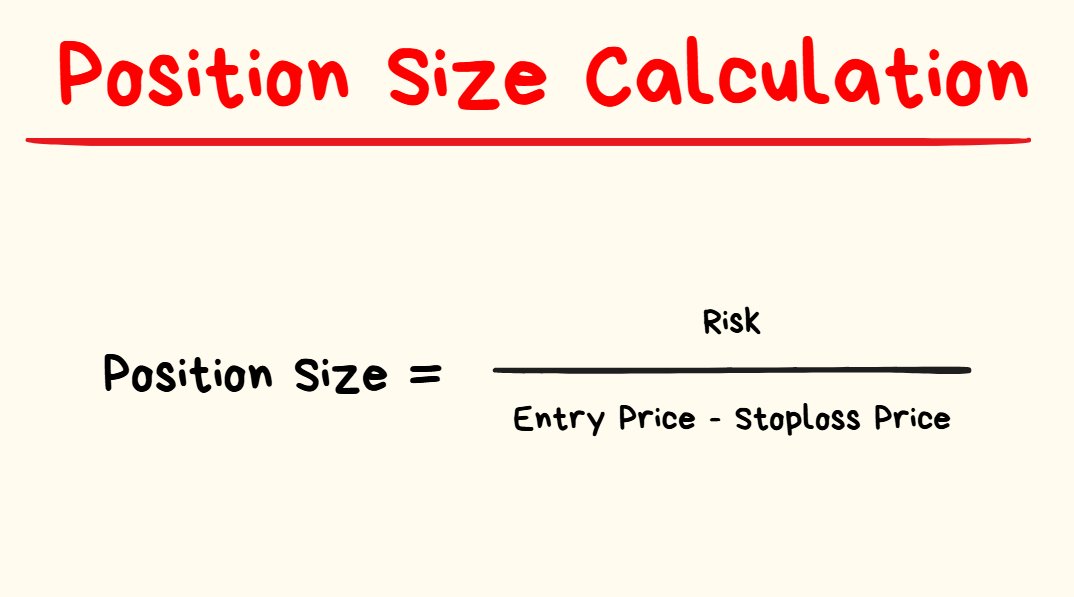
Before you panic and assume you have to “do math” before you enter every single trade, relax…
… there is an easy way to calculate it.
TradingView has the calculation built into their Risk:Reward tools ↓
Sep 21, 2025
Easiest way to calculate your Position Size relative to Risk in a Trade ↓
If you follow the 3 steps above, you’ll be able to easily see exactly how much position size you need on a trade after you just type in however much risk you want to take.
Easy peasy. Onto the final lesson 🤓
Lesson 5: Risk of Ruin + Bet Sizing
A universal Question that all traders end up asking at some point: “How much risk is the best amount of risk to take on my trades?”
The Answer: it depends. 🤷♂️
Popular Answer (which I think is a good answer by the way): Very popular advice is starting off with risking 1%~ of trading capital per trade. Meaning if you have $10,000, if you lose your next trade expect to lose -$100.
My Personal Answer: The higher the quality of the trade, bet more. The lower the quality of the trade, bet less.
Risk of Ruin + The Kelly Criterion
Let’s talk about Risk of Ruin first. 👀
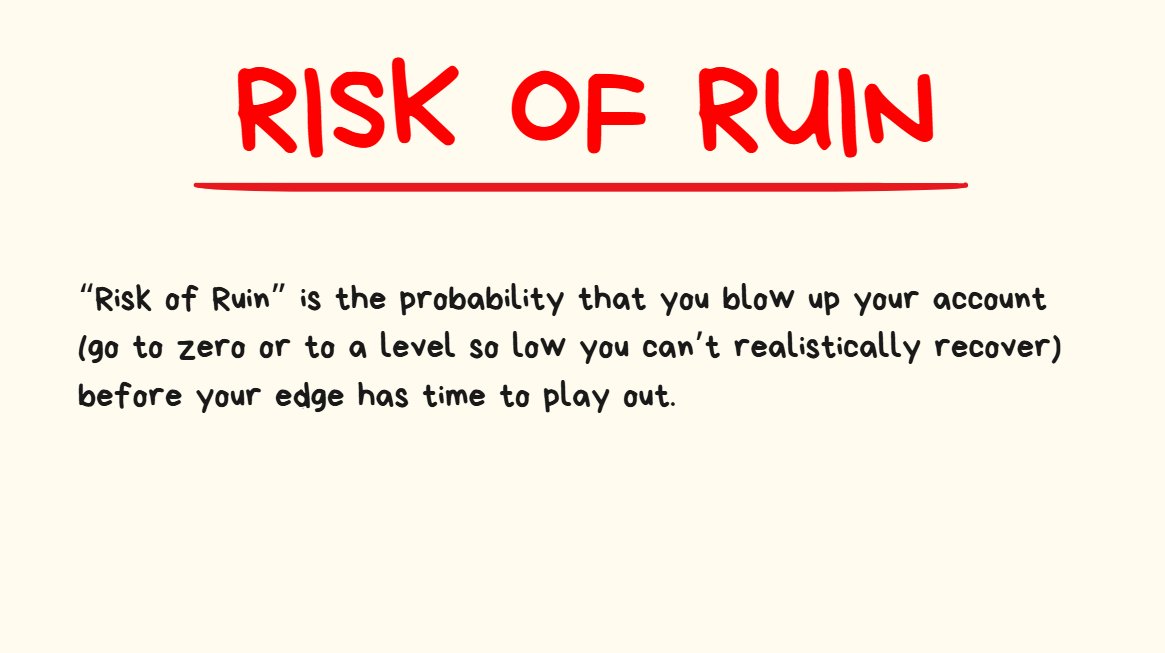
Just because you have an edge (a +EV, profitable strategy) doesn’t mean that you can’t blow up.
❗️****TIP: Rule #1 of trading is “never blow up”. If you blow up, you can’t play anymore. The whole point is to stay in the game for as long as possible.
In fact, all your chances of profitability get completely thrown out the window if you’re risking too much per 1 single bet.
Let’s use an extreme example:
- Pretend risking 100% of your Portfolio on every trade, on a strategy which has a 90% winrate with a risk:reward ratio of 10:1.
- This type of strategy is INSANELY GOOD, but the problem is if you’re going all-in every single time you are guaranteed to get wiped out eventually.
If you get wiped out, it’s game over. Even if you get “close” to being wiped out, recovering can be really really hard.
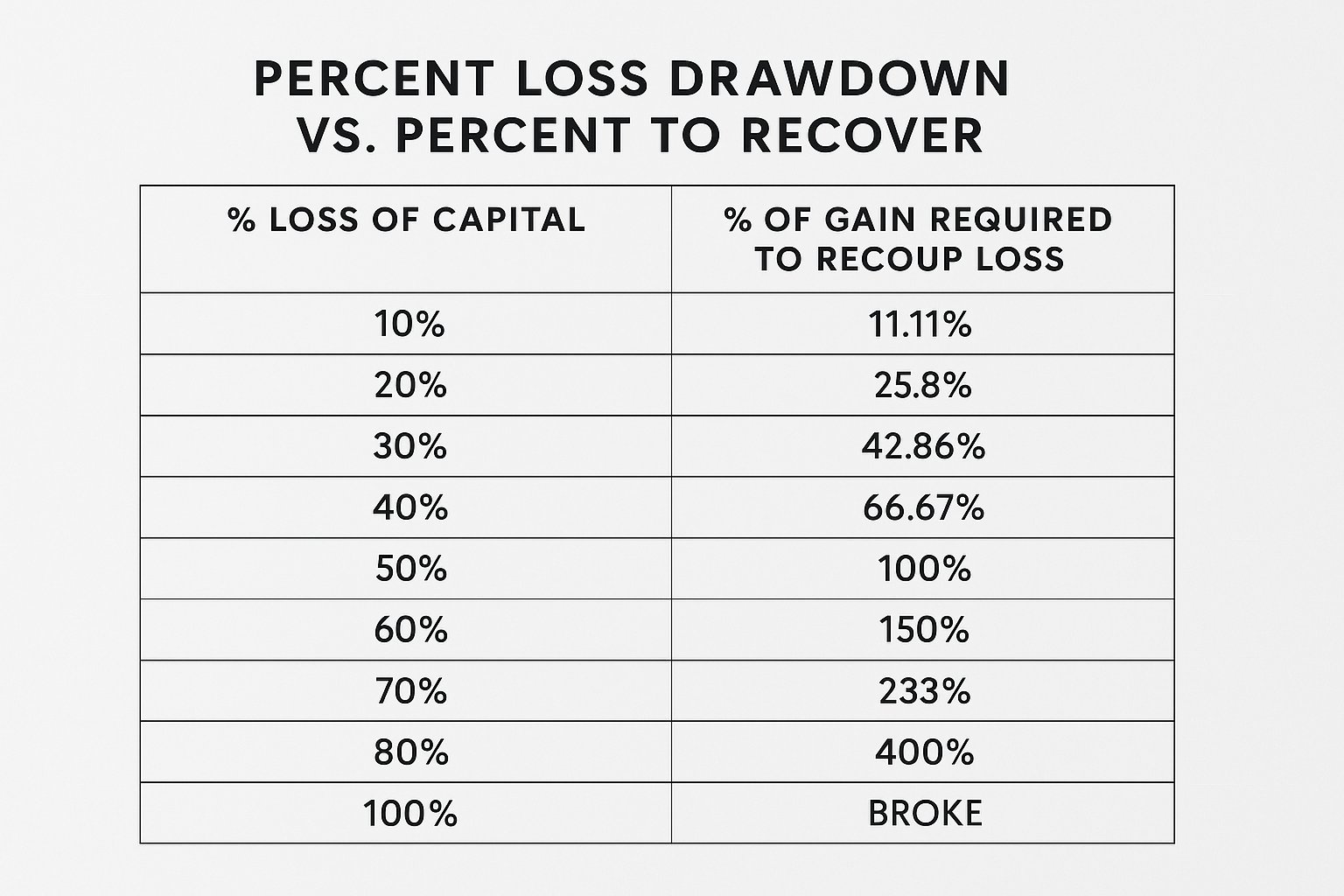
This is why growing an account feels so hard, but blowing an account feels effortless
Okay so now it should be clear that there is definitely a limit with risking too much. If we bet too big, we will blow up our account sooner or later even if we are using a good trading strategy.
But on the other hand if we risk too little, like 0.0000001% on the trade, we’re going to be little fairies who never actually end up growing an account.
So Where Is the Sweet Spot?
Let’s now talk about the Kelly Criterion, which tries to solve the riddle for the “sweet spot”. 👀
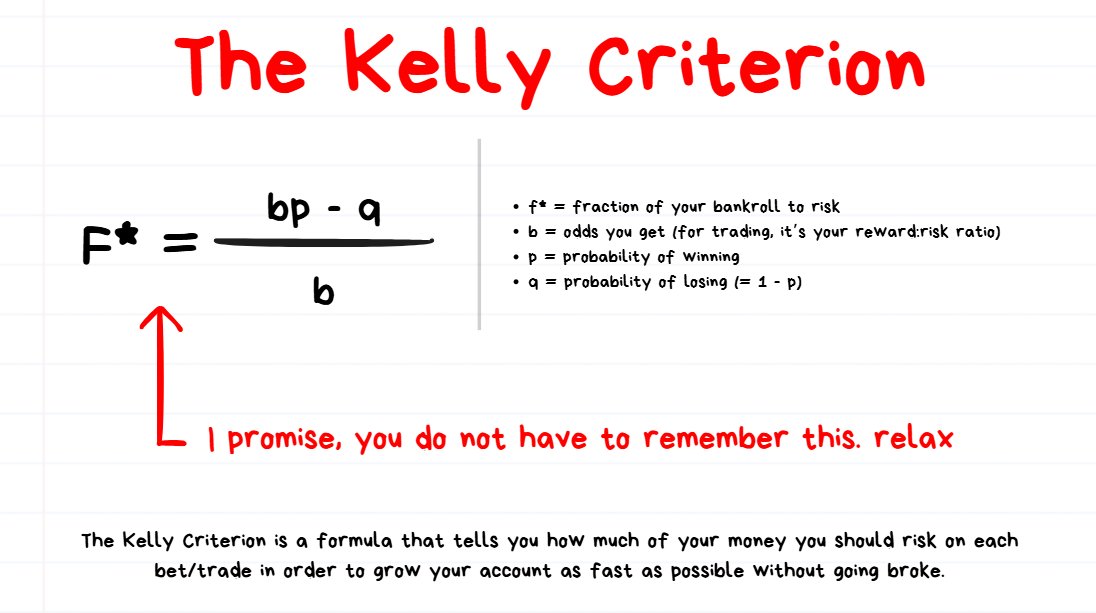
I promise, you do NOT need to remember this. I just included this for the nerds.
- Some Traders argue and say Kelly is the best approach for measuring optimal bet sizing.
- Other Traders say that it’s too conservative and slow for growth and instead take an approach to doing several multiplies of the Kelly (example: Their bet size = Kelly multiplied by 2)
- Other Traders say Kelly is still too aggressive and doesn’t take “unexpected margin of error” into account and bet even lower (example: Their bet size = Kelly divided by 2)
The Point About Kelly and Optimal Bet Sizing
- I don’t believe there is “perfect/flawless” approach to sizing your bets.
- Even if you use the Kelly or some other nerdy calculation to size your bets, nothing is perfect in the realm of trading.
As I mentioned a bit further up above, I prefer to take a “Dynamic” approach to bet sizing.
- Low Quality Trade = I don’t even bother trading these.
- Standard Quality Trade = I risk 1% on the trade.
- High Quality Trade = I risk 2% on the trade.
- Super High Quality Trade = I risk a maximum of 4% on the trade.
🤓NOTE TO READER: Is this the best approach to sizing? I have no idea! But I like to keep things simple and this approach has worked well for me.
How I measure the quality of a trade will be based on the strategy that is being used to execute it + what variables are present right before I enter the trade.
I go a lot more in-depth with “measuring trade quality” in 2 other articles that I posted.
The first one is everything with how I trade Breakouts and the other is everything to do with how I trade Reversals. You’re welcome to check them out below if you would like ↓
Jul 31, 2025
Oct 1, 2025
Summary of the 5 Lessons
- Lesson 1: Knowing the numbers behind your edge is important. Expectancy is a critical topic to understand in any “probability-based” type games such as Trading.
- Lesson 2: Remember to think about the next 100 trades and let go of the outcome of the next 1 trade. Let the law of large numbers play out.
- Lesson 3: Leverage is not a profit multiplier, it’s just a capital efficiency tool. Remember to never risk getting liquidated.
- Lesson 4: Position Size is how much of the coin you’re buying while Risk is how much money you’re going to lose if your idea is wrong.
- Lesson 5: Drawdown is naturally harder to get into than it is to climb out of. Size your bets appropriately. If you’re new, keep it simple and stick to the standard 1% per trade until getting a better understanding of your “high quality A+ trade setups”
Once again, I thank you for taking the time for pushing through this lengthy article.
If you made it this far, don’t be shy to ask questions on any topics that you want more information on in the comments.
I’ll reply to literally every single one.
🌶️
Source
Written by @spicyofc · View original post · Published: 2025-08-31